Stewart's Jewelry Logo  
 
Jewelry Class Content


   PROGRAM #1
   Jewelry Repair
program#2|program#3|


PRECIOUS METAL TERMINOLOGY, TESTING & IDENTIFICATION
Students test and identify platinum, karat of gold, and fineness of silver by using pre-mixed testing solutions. Quality and trademarks, karat and fine system, plumb and non-plumb gold are explained.
 
CLEANING METHODS
Students learn how to clean jewelry ultrasonically followed by steam cleaning. They also learn how to prevent and remove black oxidation and tarnish.
 
TORCH SYSTEMS AND FLAME ADJUSTMENTS
Types of torches (Hoke, Meco, Little and water torch), tips, gases and their application in gold, platinum and silversmith. Reducing, neutral and oxidizing flames are practiced by the students.
 
SOLDERING TECHNIQUES
How to correctly prepare an article for soldering, including two-tone, tri-color and hollow jewelry is explained. The use of fire coat, flux and anti-flux is demonstrated. Students practice the pick-up and tweezer methods of soldering.
 
SAWING - DRILLING & FILING
The correct methods for sawing, piercing, drilling, and filing metals are explained and put into practice by students.
 
SOLDERING HEADS & SHANKS
Students learn how to solder in a peg head and recess a setting. They solder two heads (settings) into a full shank in preparation for diamond setting. Expansion shanks, ball and spring guards are explained.
 
RING SIZING - PLATINUM, GOLD & SILVER
Correct procedural methods for ring sizing, ring stretching, and half shanks are explained and practiced by each student. Instructions for platinum ring sizing, working on old rings with many solder joints are explained.
 
TOOLS, FINDINGS & SUPPLIES
The tools and equipment needed for jewelry repair and diamond setting are demonstrated and used by the students.
 
DIAMOND SETTING - RUBY
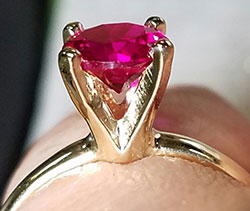
Students set a 1.00 ct. ruby by the undercut method using special burs and setting procedures. Students dress prongs with a barrette needle file.
 
DIAMOND SETTING - CUBIC ZIRCONIA
Students set a 1.00 ct. cubic zirconia by undercutting bearings using special burs and setting procedures. Students dress prongs with cup burs.
 
DIAMOND SETTING - PIN POINT
Students shellac up an illusion top and set a .06 ct. gemstone.
 
POLISHING, BUFFING & LAPPING
How to polish, buff and lap using correct compounds is demonstrated and practiced by students.
 
DIAMOND REMOVING & TIGHTENING
Student will use various methods in removing and tightening gemstones in a prong, pin point or bezel mounting.
 
PRONG WORK
Correct procedures for replacing worn prongs are demonstrated and practiced by the students.
 
RE-TIPPING
Correct procedures for re-tipping worn prongs are demonstrated and practiced by the students.
 
KARAT GOLD BEADS
Correct procedures for making karat gold beads for ball guards, safety catch and prong build-up.
 
HARDENING & ANNEALING
The use of hardening and annealing, its methods and applications are demonstrated and practiced by the students.
 
SWEAT SOLDERING
Instructions are given on sweat soldering. Each student practices this procedure.
 
BEZEL FABRICATION
Students fabricate a bezel for a coin or cabochon cut stone, burnish to tighten, and solder on a bail. SERPENTINE CHAIN
Students practice weaving a serpentine chain together so you can't see the solder joint. Special procedures are used where all the links move.
 
HOLLOW ROPE CHAIN
Students practice weaving rope chain together, soldering each link one at a time so that all the links move. Instruction is given on how to repair a hollow rope where you don't have to cut the links.
 
WIRE & TUBE DRAWING
How to draw wire to change gauge or shape is demonstrated and practiced by students. Instructions given in making straight and curved tubes.
 
SURFACE TEXTURE
The correct techniques are demonstrated in creating the following surface textures: Florentine, Telato, Rigato, Satin, Bark, Hammer, Stone, Glass, "Diamond cuts", and "Laser" finish.
 
HOLLOW JEWELRY
Instruction is given in the correct procedures for soldering and removing dents from Hollow Jewelry.
 
ELECTROPLATING
Demonstration is given in the correct procedures for rhodium and gold plating.


PROGRAM #2
Advanced Diamond Setting
program#1|program#3|


GEMSTONES - DURABILITY FACTORS AND CHARACTERISTICS
Instruction is given on the various durability factors and other characteristics, such as the dangers of cleavage, of diamonds and other gemstones in preparation for diamond setting.
 
EMERALD CUT SETTING
The techniques of undercutting a bearing into each prong and tightening the gemstone vectorally is demonstrated and accomplished by each student (prongs are dressed with cup burs or split prong).
 
GRAVERS-DESIGNING, SHARPENING & POLISHING
How to design the graver to fit the individual student's hand is demonstrated. Sharpening and polishing procedures are done by the students in preparation for diamond setting and bright cutting.
 
BEAD SETTING
Students cut a seat in a flat top setting, set stones by raising beads and form beads with beading tools. They also "work-up" beads over worn beads plus 'build-up" (karat gold beads) over worn beads.
 
STAR BRIGHT CUT SETTING
Students practice star bright cutting and bead set to tighten a gemstone.
 
CLUSTER SETTING
Bur undercutting with a bearing bur, several stones are set together in a "cluster" setting.
 
BAR SETTING
The students learn to set a gemstone in a bar setting using the setting bur and undercut methods.
 
BLOCK BRIGHT CUT SETTING
The students create a single and triple bead-set block bright cut by making "relief cuts" and bright cutting the panel walls at a 45 degree angle.
 
TIFFANY SETTING
Students set a 1.00 ct. cubic zirconia in a six prong setting.
 
CHANNEL SETTING
How to undercut, set and burnish (to tighten) channel set gemstones is taught and practiced by students. Instructions given on sizing and re-shouldering a channel set eternity ring.
 
TUBE SETTING
Students cut a bearing in a tube and burnish in a gemstone. Instruction is given on re shouldering a worn tube.
 
SPIN SETTING
Students cut a bearing and tighten gemstone in setting by spin method.
 
GYPSY SETTING
The students "hammer set" or burnish a gemstone in a gypsy setting by first undercutting a bearing.
 
OVAL SETTING
Students use special burs to set and oval stone in a six prong peg setting.
 
REVERSE SETTING
Demonstration and students "bright cut" design (reverse star and round brilliant cut). They cut a reverse seat and do reverse bead setting.
 
MARQUISE SETTING
Students undercut bearings, make "relief cuts", and set stone and dress prongs with graver. Instruction is given on the vector method of tightening.
 
PEAR SETTING
Students use a combination of special burs when undercutting bearings to match the gemstone.
 
BAGUETTE SETTING
Several methods of undercutting a bearing for a baguette stone are explained and practiced by the students.
 
WEDGE SETTING
Students layout a design, hand cut wedges and bright cut the panels. The diamond looks like it is floating above the surface and reflecting from the panels.
 
AZURED SETTING
Students make azured cuts with gravers and special burs used on rings, Excellent setting for a reversible pendant plus it lightens the weight of platinum pendants to make them easier to wear.
 
HEART SETTING
Students set a heart shaped stone in a mounting with 2 common and one vee prong.
 
PAVE SETTING "DECORATIVE BEADS"
Students layout a design using small gemstones to cover the surface. Special techniques are taught for making decorative beads, the most popular form of pave setting.
 
PAVE SETTING "BRIGHT CUTS"
Students layout a seven stone cluster with star bright cuts. This is a very attractive setting in a ring or pendant.
 
PAVE SETTING
Students layout, shellac up article and use special burs to cut away all the metal between the stones so that you see no metal with the surface completely covered with diamonds.
 
THREAD SETTING "DIAMOND CUTS"
Students layout a thread design with proper spacing and a variety of "Diamond Cuts". Demonstration given on 2 bead, 4 bead and 5 bead thread designs. This is excellent for diamonds set in initials and borders.
 
INVESTMENT SOLDERING
An extremely helpful method in designing jewelry by holding many small settings together for soldering is explained and demonstrated. Excellent for filigree repair and soldering settings to a foundation ring shank, plus designing and soldering together a cocktail ring.
 
TRILLION SETTING
Students set a Trillion stone in a mounting and dress prongs with Engraver.


PROGRAM #3
Design/Casting
program#1|program#2|


TYPES OF WAXES & THEIR APPLICATIONS
A varied selection of waxes on the market for the jeweler-craftsman are available for demonstration and by the students. Their specific uses and applications are discussed and demonstrated.
 
CREATING WITH FILING WAX
Students design and create several wax patterns. Ring sizing is demonstrated and practiced.
 
FABRICATION WITH WAX WIRES AND SHEETS
Students construct an article of jewelry using wax wires and sheets.
 
MODELING AND WAX CARVING WITH THE FLEX-SHAFT
Using the electric flex-shaft and an assortment of burs to carve and texture wax is the procedure taught and practiced here.
 
WAX SPRUING
Spruing procedures are explained and students sprue their completed wax pattern rings in preparation for casting.
 
WAX AND METAL WEIGHING METHODS
The correct method for computing the amount of metal needed to cast the student's wax models is demonstrated and accomplished by each student.
 
INVESTMENT MIXING AND DE-BUBBLIZING
The correct methods for measuring, mixing and de-bubblizing investment are demonstrated. Each student invests and prepares a flask for burnout.
 
BURNOUT PROCEDURES FOR WAX ELIMINATION
Instruction is given for correct burnout temperatures and burnout times needed for different sized flasks.
 
METAL MELTING METHODS
Different methods for melting the casting metal are explained. Included are various torch systems and melting furnaces.
 
CENTRIFUGAL CASTING
Each student casts his individual flask in a spring-loaded, split arm centrifugal casting machine. Balancing, winding, actual casting procedure, and quenching of the flask are demonstrated and then accomplished by each student.
 
ELIMINATING POROSITY FROM CASTINGS
All procedures and precautionary measures for eliminating porosity in castings are explained.
 
POLISHING AND FINISHING TECHNIQUES FOR CASTINGS
Various techniques and proper procedures for finishing and polishing finished metal castings are explained and demonstrated. Each student polishes and buffs their completed castings.
 
TUMBLING
Techniques for cleaning finished castings are demonstrated
 
REPLICA CASTING ORGANIC/INORGANIC
How to cast objects made of different materials, other than wax, procedures for organic and inorganic objects such as insects, flowers or plastics, are explained.
 
VULCANIZED RUBBER MOLDS
How to pack, vulcanize and cut rubber molds is demonstrated and practiced by each student. Instruction is given on cutting locks, plugs, air vents, etc.
 
WAX INJECTION
Students are instructed in the use of air pressure wax injection, for filling rubber molds.
 
VACUUM CASTING
The students participate in a class demonstration of vacuum casting, using a perforated flask and a vacuum casting machine.
 
TOOLS, EQUIPMENT AND SUPPLIES
What equipment is best suited and applicable to different situations is discussed at length.


STEWART'S INTERNATIONAL SCHOOL FOR JEWELERS
651 W. Indiantown Road, Jupiter, Florida 33458
1-800 843-3409 (toll free)
1-561 746-7586
FAX 1-561 746-8420

Home | Programs | Class Outline | Introduction | Schedule | General Information
Policy | Facilities |


Page created and maintained by: SeafishNet
Changes last made on: September 21, 2007
 
©